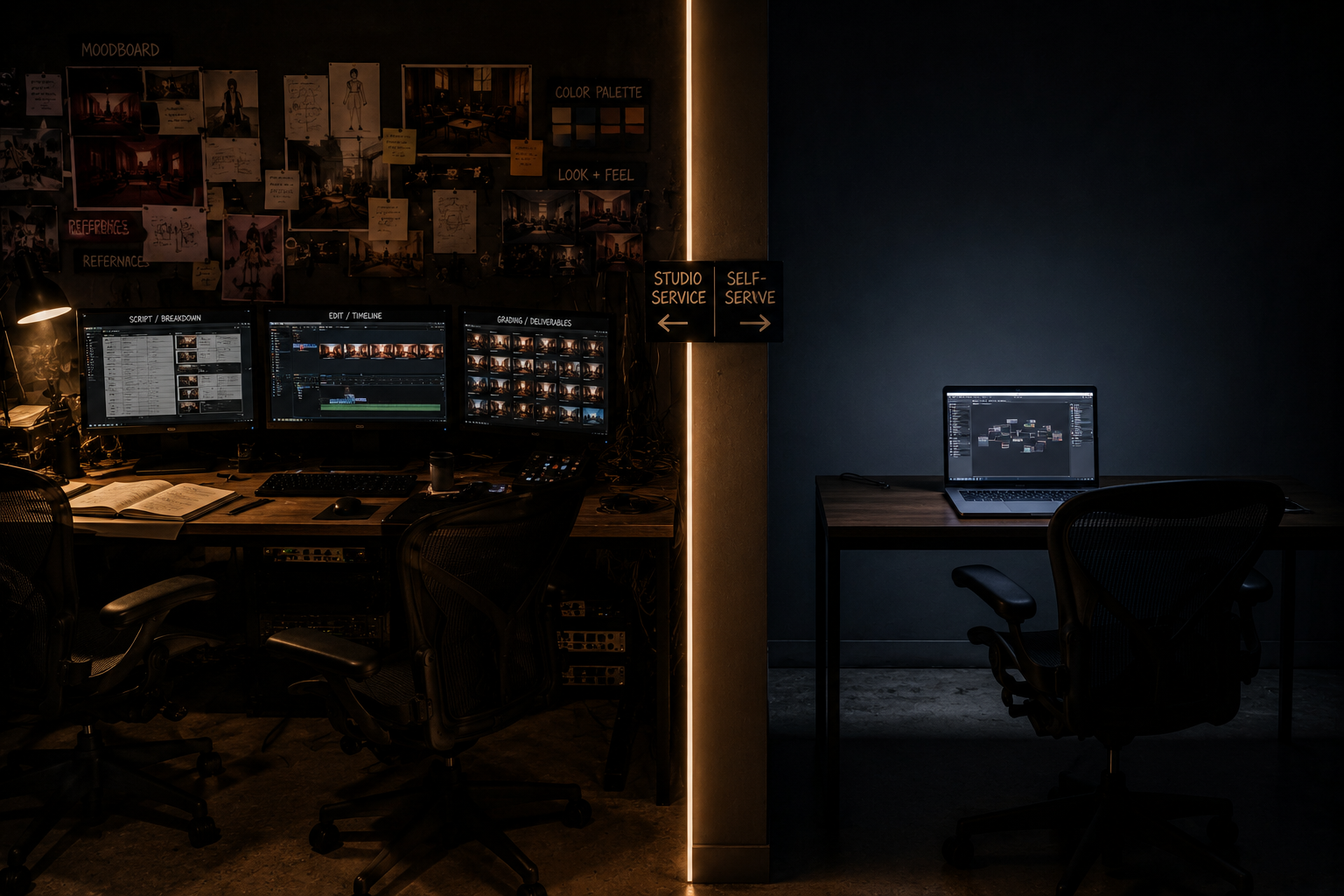
The decision to outsource AI microdrama production to a service studio or build on a self-serve platform like MinionArts Vertex comes down to three variables: how much creative control matters, whether you intend to produce one series or many, and whether your team's time cost is higher than the platform learning curve. In 2026, both paths are commercially viable and the right answer is genuinely different for different types of operators. This is the honest decision framework.
What a microdrama production service provides
A full-service AI microdrama studio provides scriptwriting, character design and lock, pipeline operation, generation, review, assembly, and delivery of finished vertical masters. The client specifies the genre, the brief, the target platform, and the episode count, and receives finished episodes. The production service handles the Vertex canvas, model routing, character reference management, lipsync, music, subtitles, and QC. Cost structure: service studios in 2026 typically price at $500 to $2,000 per finished episode for AI-native production, positioning against the $3,000 to $5,000 that live-action microdrama production commands in comparable markets. For a 50-episode season, a service engagement runs $25,000 to $100,000 all-in.
The service path is the right choice when the client has strong story and brand direction but no in-house production capability, when the production is a one-time series without recurring volume, when the timeline is compressed and there is no runway to build pipeline knowledge, or when the client is a platform or broadcaster that needs a demonstrated production sample before committing to an internal capability build.
What self-serve on MinionArts Vertex provides
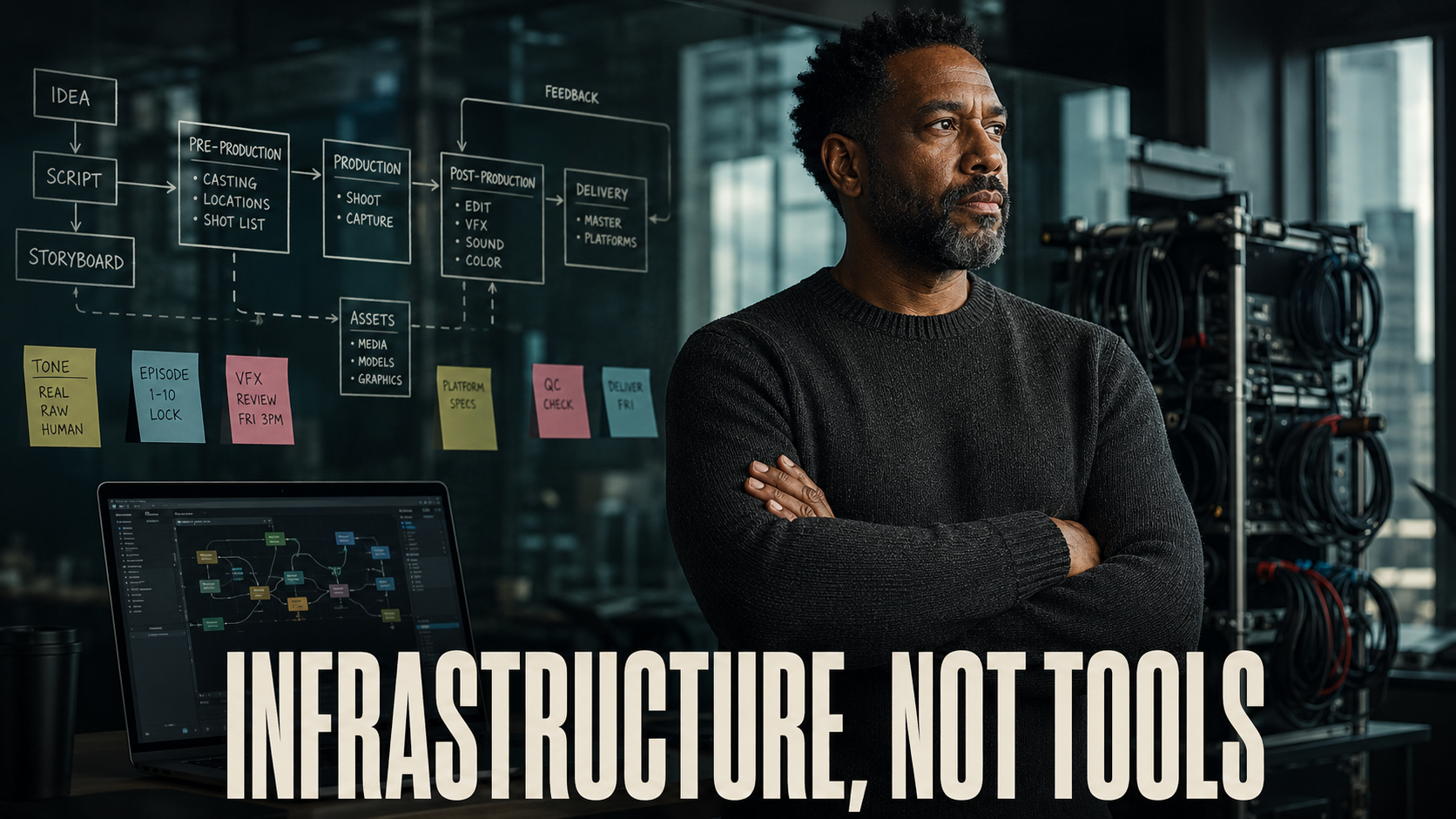
Building on MinionArts Vertex directly gives a studio or brand full creative and operational control of the production pipeline. The canvas holds the full workflow: character lock, scene JSON ingestion, model routing across Kling 3.0, Seedance 2.0, Veo 3.1, and value-tier models, voice and lipsync nodes, music and assembly, and 9:16 export. The Interface Form layer means non-technical creative staff can operate episode production without touching nodes. The Director Node automates season iteration with human review at the output stage. The JSON template export means each production builds institutional knowledge that compounds across series.
The self-serve path costs: Vertex platform subscription, plus generation credits at $950 to $1,700 per 50-episode season in direct generation cost, plus creative labor at the studio's own rate. Total season cost runs $5,000 to $15,000 for the first season, declining to $3,000 to $8,000 from the second season onwards as the template is established. For a studio producing 3 or more seasons per year, the self-serve economics become significantly better than service cost by year one. For a studio producing 10 seasons per year, the self-serve path at $50,000 to $80,000 total production cost is 3 to 4 times cheaper than a service engagement at equivalent output.
The hybrid path: MinionArts Vertex with production support
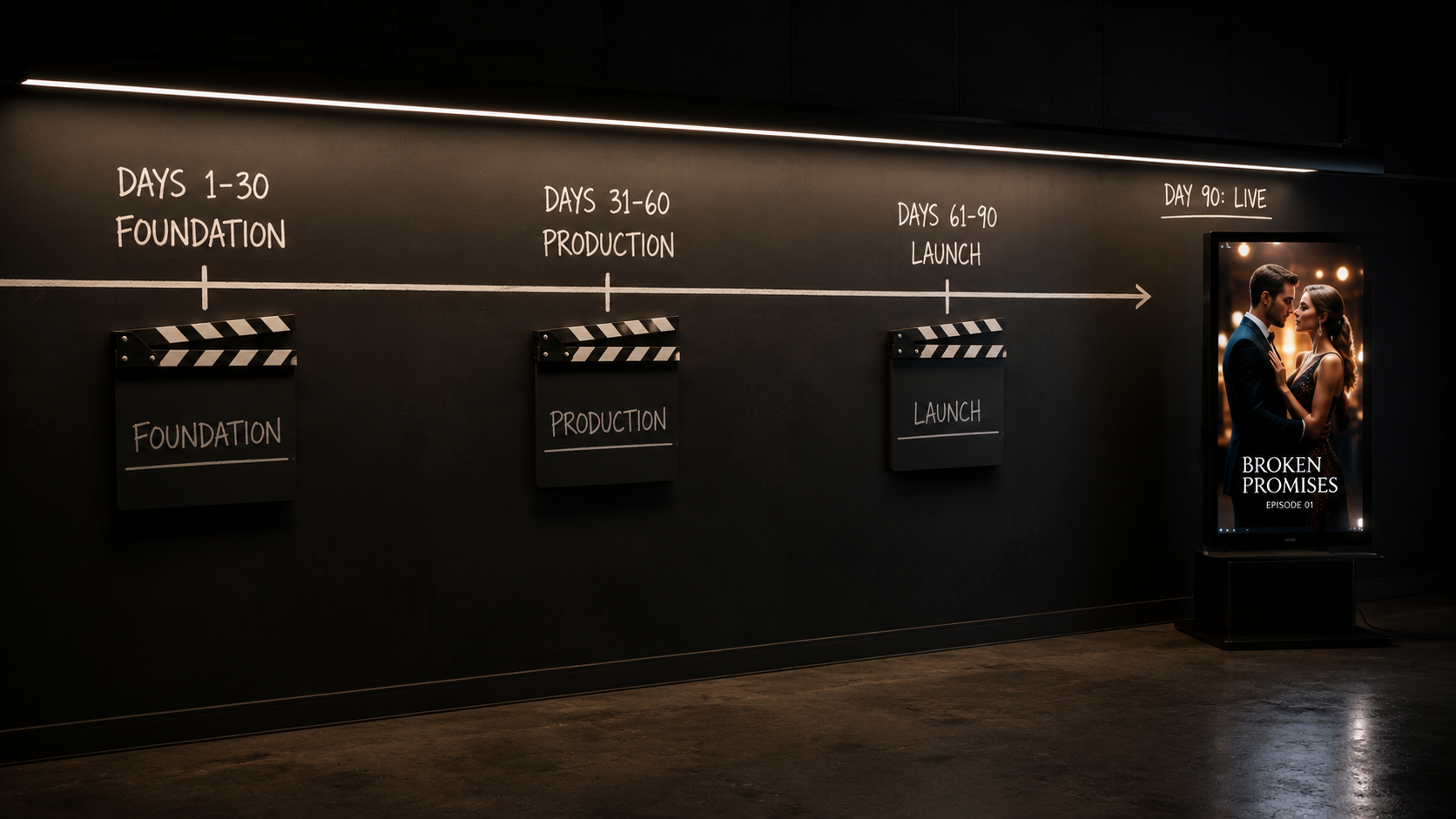
The most practical path for platforms and brands entering microdrama for the first time in 2026 is a hybrid: a production partner who builds and validates the Vertex pipeline for the first season, trains the internal team on Interface Form operation, and hands off the template for subsequent seasons. This captures the setup efficiency of a service engagement and the recurring economics of self-serve from the second season forward. MinionArts offers this as a studio service mode: the first season runs as a managed production with full pipeline build-out, character library creation, and platform delivery, establishing the template that the client's team then operates independently. The effective cost of this path is the service rate for season one and the self-serve rate for every subsequent season, which is the unit economics that most quickly reaches studio-level profitability.
The questions that determine the right path
Four questions clarify the decision. First, how many seasons do you intend to produce in the next 12 months? One to two seasons: service path or hybrid. Three or more: self-serve or hybrid. Second, does your team include anyone with AI pipeline operation experience? Yes: self-serve from the start with Vertex onboarding. No: service or hybrid for season one. Third, is creative control of the character design and story direction core to your brand or platform identity? Yes: self-serve, because service studios make design decisions you may not be able to reverse. No: service path works. Fourth, are you building a content studio as a business or producing content for a specific campaign or distribution deal? Studio: self-serve for compounding economics. Specific project: service for speed and no ongoing platform commitment. The Vertex canvas is designed to serve both paths from the same technical foundation, which is why it functions as both the production tool for independent studios and the platform on which MinionArts' own service engagements are delivered.