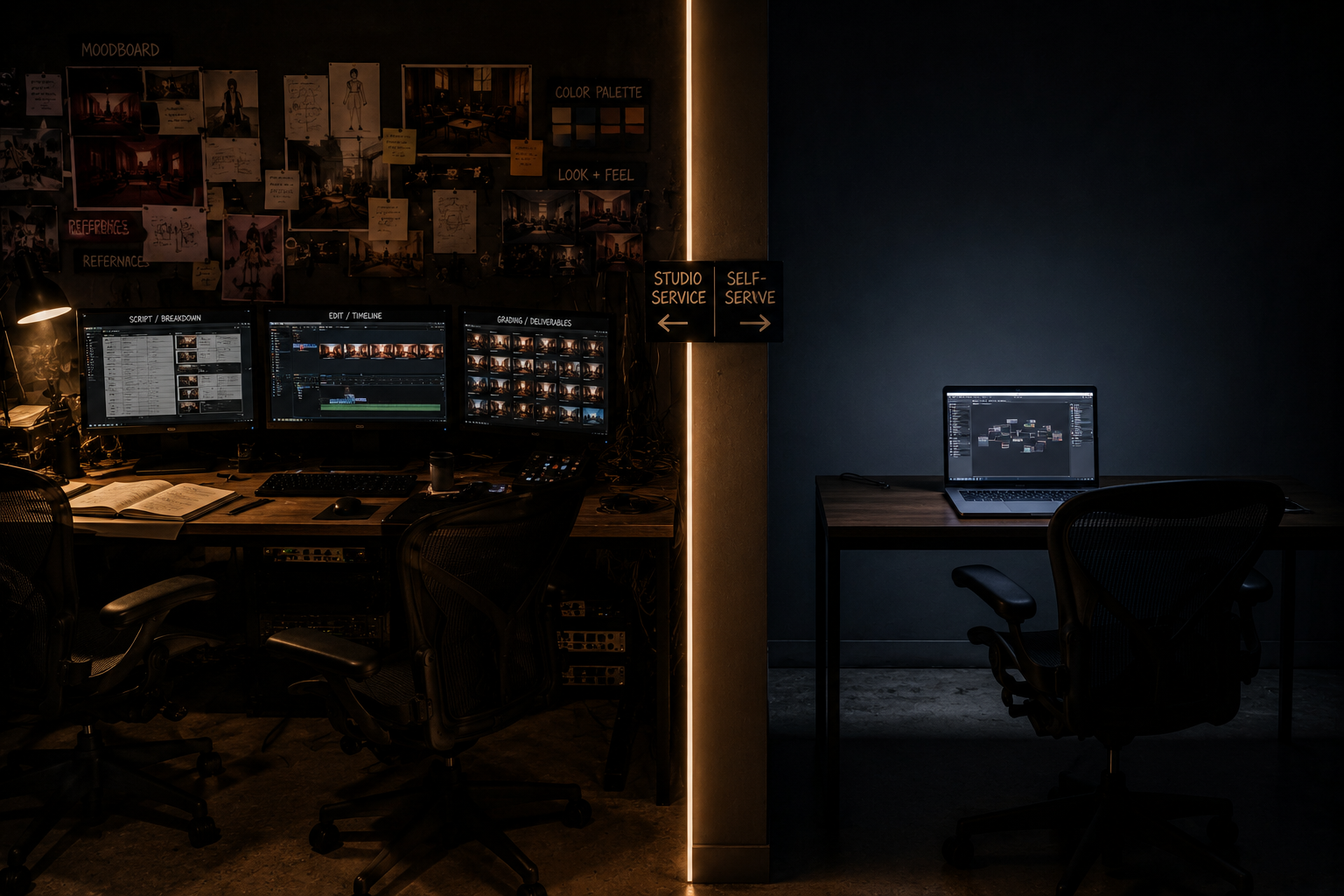
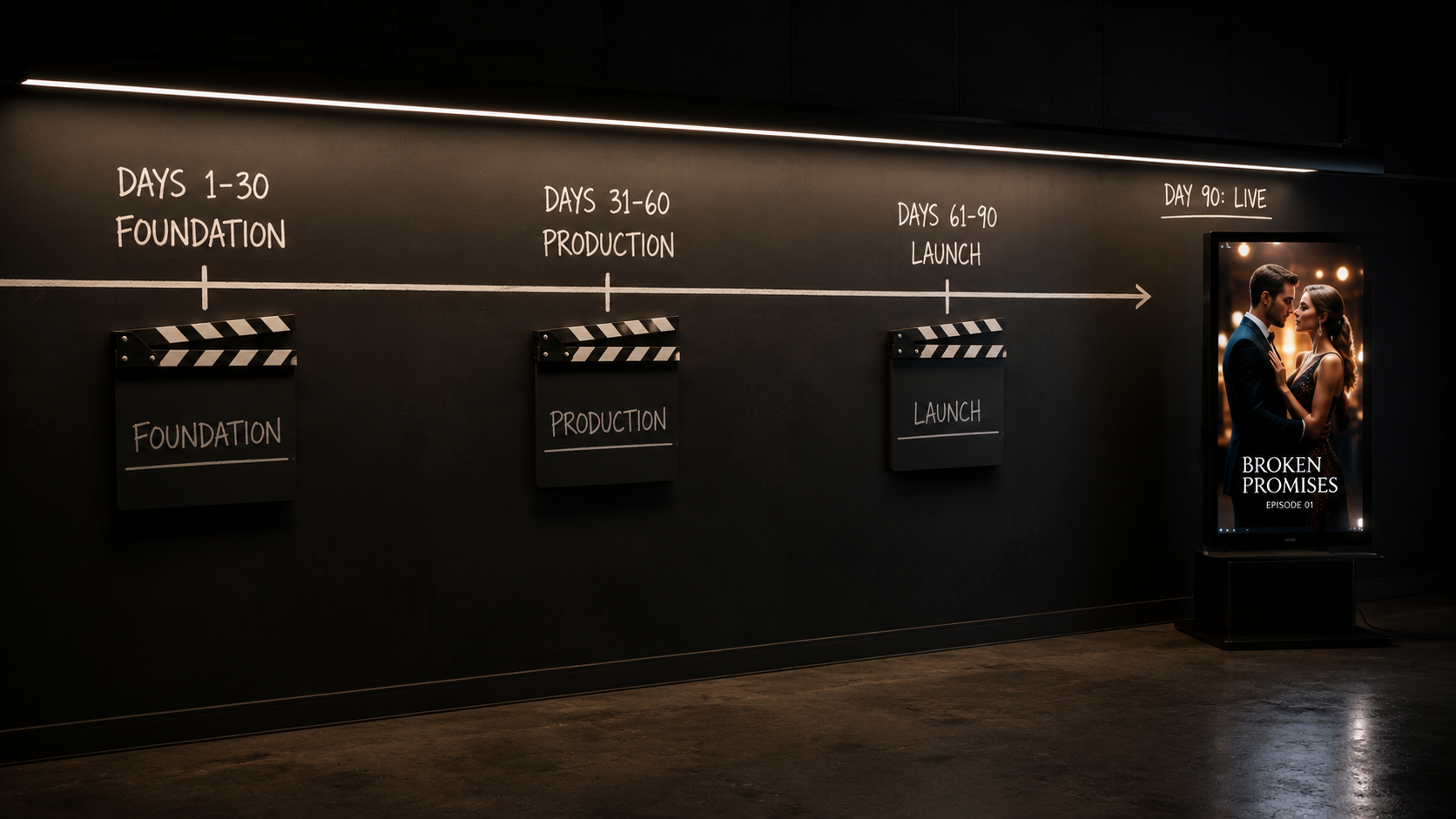
Launching a vertical drama channel in 90 days from zero is achievable with an AI production pipeline in 2026. China's production teams deliver 100-episode seasons in 3 to 6 months at the shudian model; AI pipelines on MinionArts Vertex compress that to 4 to 6 weeks per season for teams that build the infrastructure correctly upfront. The 90-day timeline here is not a production sprint. It is a structured market entry: the first 30 days establish the foundation, the second 30 days produce the first deliverable season, and the final 30 days distribute, iterate, and position the channel for sustained output. Here is the complete playbook, week by week.
Days 1 to 30: foundation
Week 1: genre, platform, and pipeline decisions. The first week is strategic, not operational. Choose your primary genre based on the production advantage analysis and your target audience: mythology-fantasy if you want the strongest AI production edge and genre differentiation; romance if you want the highest probability of platform acceptance and unlock conversion; romantasy or supernatural if you are targeting US and European markets where these hybrid genres are growing fastest. Choose your primary distribution platform: ReelShort for English-language premium originals, DramaBox for broader genre range and global reach, Kuku TV or Pocket TV for India-first content, ShortMax for Southeast Asia. Research the submission requirements for your target platform and design your series to those specifications: episode count, length, format, content standards.
Week 2: season bible and character design. Write the season bible in the first half of the week: premise in one sentence, lead characters with core want and wound, act-level arc across 50 episodes, placement of major reveals relative to the episode wall at episode 6 to 8. Begin character lock in the second half: generate reference libraries for every lead character and every recurring location. This is the highest-leverage production week; every hour spent strengthening character lock saves generation credits across the full season. On MinionArts Vertex, load the genre-appropriate base template and configure the character reference nodes with the validated reference library before any episode work begins.
Week 3: beat sheet and pipeline test. Write the full 50-episode beat sheet in the structured JSON format that Vertex's Interface Form accepts: hook beat type, friction escalation, spike content, Zeigarnik cut type, intensity register, dialogue lines per beat. Run a 3-episode pipeline test to validate character consistency, model routing, audio synchronization, and assembly output. Address every technical failure at this stage before running the full season, because a failure mode discovered at episode 30 costs 30 episodes of effort to correct. Week 3 produces 3 validated test episodes and a confirmed production system.
Week 4: multilingual and distribution preparation. Configure the multilingual pipeline for your target language markets. Set up the ElevenLabs voice IDs per character per language. Test one episode in each target language to validate lipsync and subtitle output. Research platform submission portals, create producer accounts, and review content guidelines for every target platform. Produce the episode one paid social hook clip at Veo 3.1 quality for platform submission and paid acquisition testing.
Days 31 to 60: production
Weeks 5 and 6: main generation run. The Director Node runs the season beat sheet across episodes 4 to 30, generating in batches of 5 to 10 while the producer reviews the previous batch. Target a review pace of 1 to 1.5 hours per episode: character consistency check against reference library, Zeigarnik cut timing confirmation, audio-video sync verification, subtitle placement review. Flag failed generations for re-run before the batch closes. The generation cost across this period runs $400 to $700 in model credits depending on tier routing and usable-take rate.
Weeks 7 and 8: episodes 31 to 50 and QC. Complete the season generation run. Run the multilingual pipeline for each additional target language. Conduct full QC pass across all 50 episodes: character consistency across the full run (checking episode 1 against episode 50 for the clearest consistency test), cliffhanger placement at every episode end, audio mix levels per platform specification, subtitle burn position. Produce thumbnail assets from the hook frame of each episode. Package season-level metadata: series title, synopsis under 150 words, episode titles and per-episode synopses, content ratings for each target platform.
Days 61 to 90: distribution and iteration
Week 9: platform submission. Submit the season to your primary distribution platform with the full metadata package. Submit simultaneously to secondary platforms where your series fits. Begin paid social testing with the episode one hook clip in your primary market at a $100 to $300 test budget, testing 2 to 3 hook variants to identify the highest-converting opening frame before committing to scale.
Week 10: data and iteration. Review the first platform analytics: episode-level retention curves, unlock conversion at the episode wall, drop-off timestamps. A retention drop at episode 8 means the wall-adjacent twist is not strong enough. A low conversion rate means the hook is not building enough anticipation before the paywall. Use this data to revise the beat sheet for season 2, adjusting the intensity register, the wall placement, and the hook structures that underperformed. The platform data from season 1 is the brief for season 2, and the Vertex template from season 1 is the production infrastructure for season 2.
Weeks 11 and 12: season 2 setup and channel positioning. Begin the season 2 beat sheet with revisions informed by the season 1 data. The 4 to 6 week production timeline for season 2 means it is in generation before the season 1 data period closes, which is the cadence required to maintain platform presence and catalog growth. Establish the channel's public presence across the platforms where the series is live, with consistent series branding and episode drop announcements. At 90 days, the channel exists as a distributable 50-episode season on at least two platforms, with a season 2 pipeline already in production. That is the baseline for a vertical drama channel with compounding economics. MinionArts Vertex carries the production infrastructure from day one to the end of that horizon.