
The global microdrama economy reached an estimated $11 billion in 2025 and is projected by Omdia to hit $14 billion by the end of 2026, a market built almost entirely in five years. China created the model: revenue there grew from roughly $500 million in 2021 to $7 billion in 2024, and in 2025 duanju revenue surpassed the country's entire theatrical box office. Now the same playbook is scaling internationally, with the United States already a $1.5 billion market in 2026, and AI production has turned China's microdrama industry into the world's first mass application of generative video. This is the data picture, and the operating system behind it.
The headline numbers
Across the major research houses, the 2026 figures converge on the same story at different scopes. Omdia puts total global microdrama revenue at $14 billion by end of 2026, with $3 billion generated outside China and the US accounting for half of that international total. Deloitte, measuring in-app revenue specifically, forecasts growth from $3.8 billion in 2025 to $7.8 billion in 2026, more than doubling in a year. Sensor Tower measured $2.98 billion in short drama in-app purchases in 2025, up 115 percent year over year, the third-fastest growing app category it tracks. Media Partners Asia projects China alone reaching $16.2 billion by 2030 at an 11.5 percent compound annual growth rate, with the US climbing from $819 million in 2024 to $3.8 billion by the end of the decade.
The engagement data may matter more than the revenue. In Q4 2025, microdrama apps drove 733 million global downloads versus 658 million for long-form streamers. US ReelShort users average 35.7 minutes per day in app, ahead of mobile Netflix at 24.8, Prime Video at 26.9, and Disney+ at 23. In Mexico, DramaBox daily usage beats Prime Video and Disney+. As Omdia framed it at MIP London in February 2026, microdramas are winning attention before they win scale: Netflix still has roughly 12 million US monthly active mobile users to ReelShort's 1.1 million, but the intensity gap runs the other way.
What China actually built
The lazy reading of duanju is that China made TV shorter. What it actually built, as a March 2026 Harvard Business Review analysis described it, is a complete operating system: a production methodology, an algorithmic growth engine, and a modular monetization stack. Three components matter.
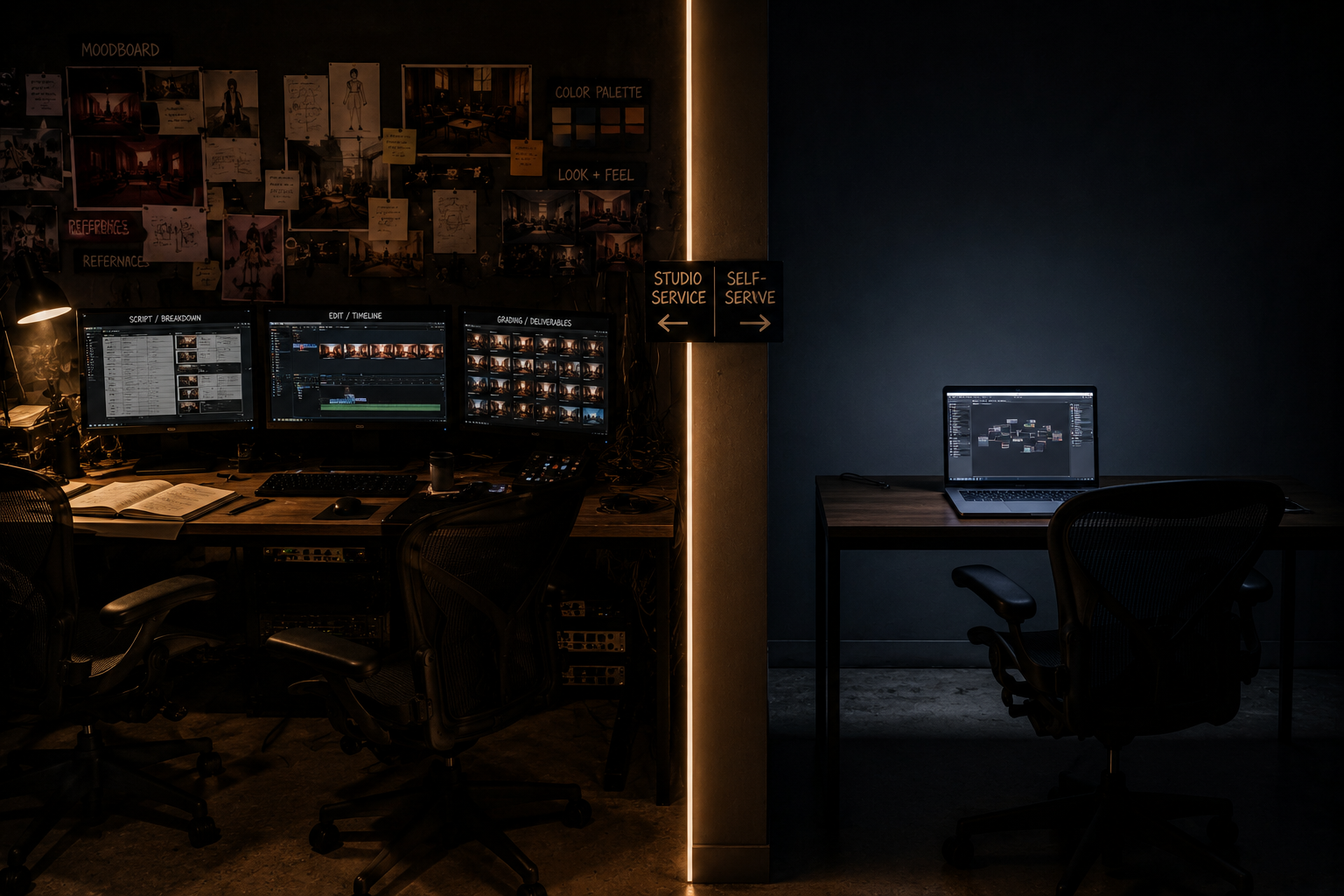
Industrialized production. Purpose-built vertical studio complexes known as shudian place banquet halls, hospital wards, and mansion sets side by side so crews shoot scenes back to back. Seasons wrap in 7 to 12 days at budgets under $300,000, roughly $2,000 to $3,000 per finished minute. Compare Quibi, which spent on the order of $100,000 per minute slicing Hollywood content into mobile pieces and shut down within a year. China designed for the phone from the ground up; Quibi reformatted for it.
Algorithmic distribution. Series launch as ad creative first. Performance marketing teams test hooks across Douyin and ad networks, double down on what converts, and kill what does not. The story is the funnel.
Modular monetization. Free episodes hook the viewer, the episode wall converts them, coins and subscriptions extract value, and rewarded ads monetize everyone who will not pay. Inside China the mix leans on advertising, e-commerce tie-ins, and brand sponsorship; internationally it leans on in-app purchases.
The AI inflection of 2026
In January 2026, a new AI-generated microdrama went live on a Chinese platform roughly every 90 seconds. DataEye tracking shows more than 10,000 AI-generated animated titles releasing monthly since the start of 2026, and about 50,000 AI-native titles were added to Douyin in March alone. The share of AI-generated content in China's top charts rose from 7 percent to nearly 40 percent within a year. Production costs run at roughly one tenth of live action, usable footage rates exceed 90 percent, government subsidies support the build-out, and state broadcaster CCTV released its own AI-generated drama in January 2026 as an official endorsement.
AI also widened the format's creative range. Mythological fantasy, historical epics, and battle-scale sequences that were impossible at vertical budgets are now routine, because the marginal cost of a spectacle shot collapsed. The constraint moved from what can be shot to what can be engineered well, which is why pipeline discipline (consistent characters, structured prompting, model routing) is the real moat. That pipeline layer is exactly what node-based platforms like MinionArts Vertex productize for teams outside China.
The international platform race
Outside China, two platforms dominate: ReelShort, with roughly $400 million in 2024 revenue and over $1.2 billion in 2025 gross consumer spending, still loss-making on heavy marketing; and DramaBox, which proved profitability with $323 million revenue and $10 million net profit in 2024. Together they held about 70 percent of global short drama in-app purchases in early 2025, and both passed 50 million monthly active users. The challenger tier is moving fast: ShortMax posted 3,888 percent year over year revenue growth into 2024 and supplies content to TikTok's PineDrama, which launched in early 2026 alongside ByteDance's Melolo. The audience core is consistent across markets: predominantly women, 25 to 60, binging romance, CEO, and revenge arcs, with genre expansion into true crime and documentary now underway.
The friction points are equally clear. Customer acquisition is brutal, with 68 percent of US microdrama ad spend going to social networks and return on ad spend swinging between 0.7 and 1.6 by title. Saturation is rising, content homogeneity at the low end is severe, and the SAG-AFTRA 2026 contract now writes vertical microdrama provisions into Hollywood labor terms.
What this means if you produce content
Three takeaways travel. First, the format is validated at global scale; the question for producers is no longer whether the market exists but how to enter it without Chinese studio infrastructure. Second, AI production is how small teams compete: the cost curve that took China five years of physical studio build-out is available today as a generative pipeline. Third, conversion engineering beats content volume; the winners pair throughput with disciplined hooks, walls, and cliffhangers. Our pipeline walkthrough covers the production side, and the monetization guide covers the conversion side. When you are ready to build, MinionArts Vertex gives you the studio China built, on one canvas.