
Yes, one person can run an AI microdrama studio in 2026, with two conditions: the pipeline must be templated rather than hand-operated, and the solo producer must accept that their real job is editorial judgment, not generation. A 60-episode vertical season that required a crew, cast, and a sub-$300,000 budget in live action now compresses into a five-to-six week solo production cycle on a node-based AI pipeline. The catch is that AI absorbed the labor of production but not the judgment of it. Here is the honest breakdown of what the machine does, what you still do, and the math of whether it works.
What a microdrama season actually requires
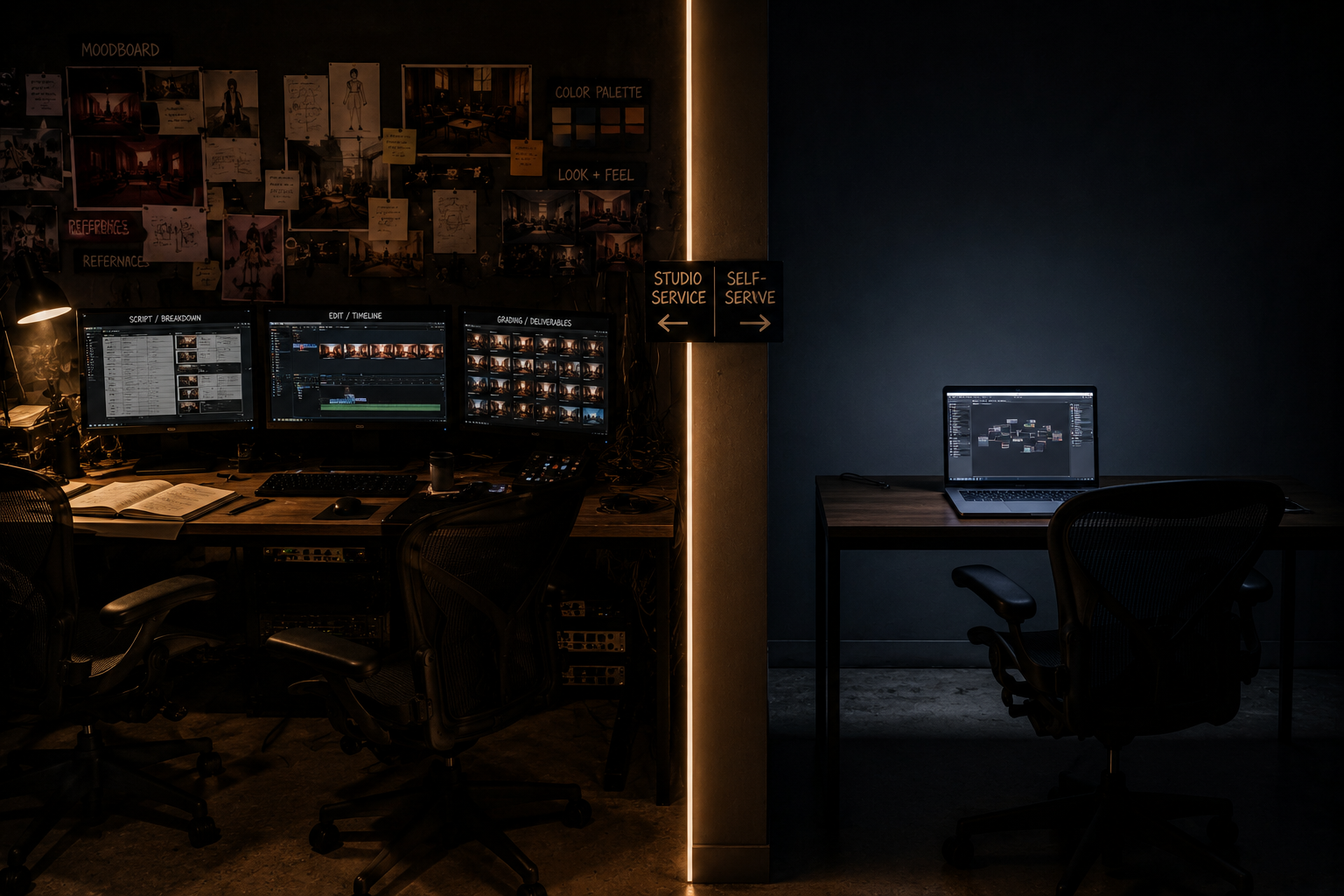
Strip a vertical season to its functional roles and you get roughly ten: writer, director, casting, cinematography, performance, locations and art, editing, sound and music, subtitling and delivery, and the producer function coordinating all of it. Live-action vertical studios compress these aggressively already, shooting full seasons in 7 to 12 days inside purpose-built studio complexes. The AI question is which of these roles a generative pipeline absorbs outright, which it transforms, and which it leaves on the human side of the table.
What the pipeline absorbs
Five roles convert almost entirely to pipeline stages. Casting becomes character lock: image models generate your leads, and a locked reference library replaces the casting call. Cinematography becomes shot generation with model routing: Kling 3.0 for directed motion, Seedance 2.0 for dialogue and lipsync, Veo 3.1 for hero shots. Performance becomes prompt and reference direction; locations and art become generated environments, with the spectacle genres that were impossible at vertical budgets, mythology, period, battle scale, now routine because the marginal cost of an expensive-looking shot collapsed. Sound becomes a locked voice ID per character plus a small reusable music cue library. The benchmark numbers exist at industrial scale: Chinese AI pipelines report production costs around one tenth of live action with usable footage rates above 90 percent, and platforms have shipped AI seasons in six weeks at a reported 90 percent cost reduction.
What stays human
Three functions do not compress, and they are where solo studios live or die. First, story engineering: the beat sheet discipline of hooks by second 30, turns near second 60, cliffhanger cuts, and twist placement around the episode wall is conversion mechanics, and AI does not yet have taste for it. The market's own quality problem proves the point; with tens of thousands of AI titles releasing monthly, homogeneity at the low end is severe, and researchers note AI still shows gaps in rendering believable human behavior. Second, review: a 90 percent usable-take rate still means one in ten shots fails, and across 500 plus generations per season someone must catch the drifted face and the dead-eyed reaction. Third, the funnel: hook testing, wall pacing, and per-market tuning are an analytics discipline. The solo producer is not a one-person crew. They are a showrunner with a render farm.
The workflow that makes one person enough
The difference between a solo producer who ships and one who drowns is whether the pipeline is a template or a routine. Hand-operating five tools per shot across 60 episodes is thousands of manual handoffs; no individual sustains it. The viable pattern is the one node-based platforms productize. On MinionArts Vertex, the full episode pipeline, script ingestion through character-locked generation, lipsync, music, subtitles, and 9:16 export, is built once on a canvas and exported as a JSON template. Interface Forms expose only the per-episode variables, and the Director Node can step through a season beat sheet episode by episode while the human approves outputs. The solo producer's day becomes write, queue, review, not operate. That inversion is the entire feasibility argument.
The realistic solo math
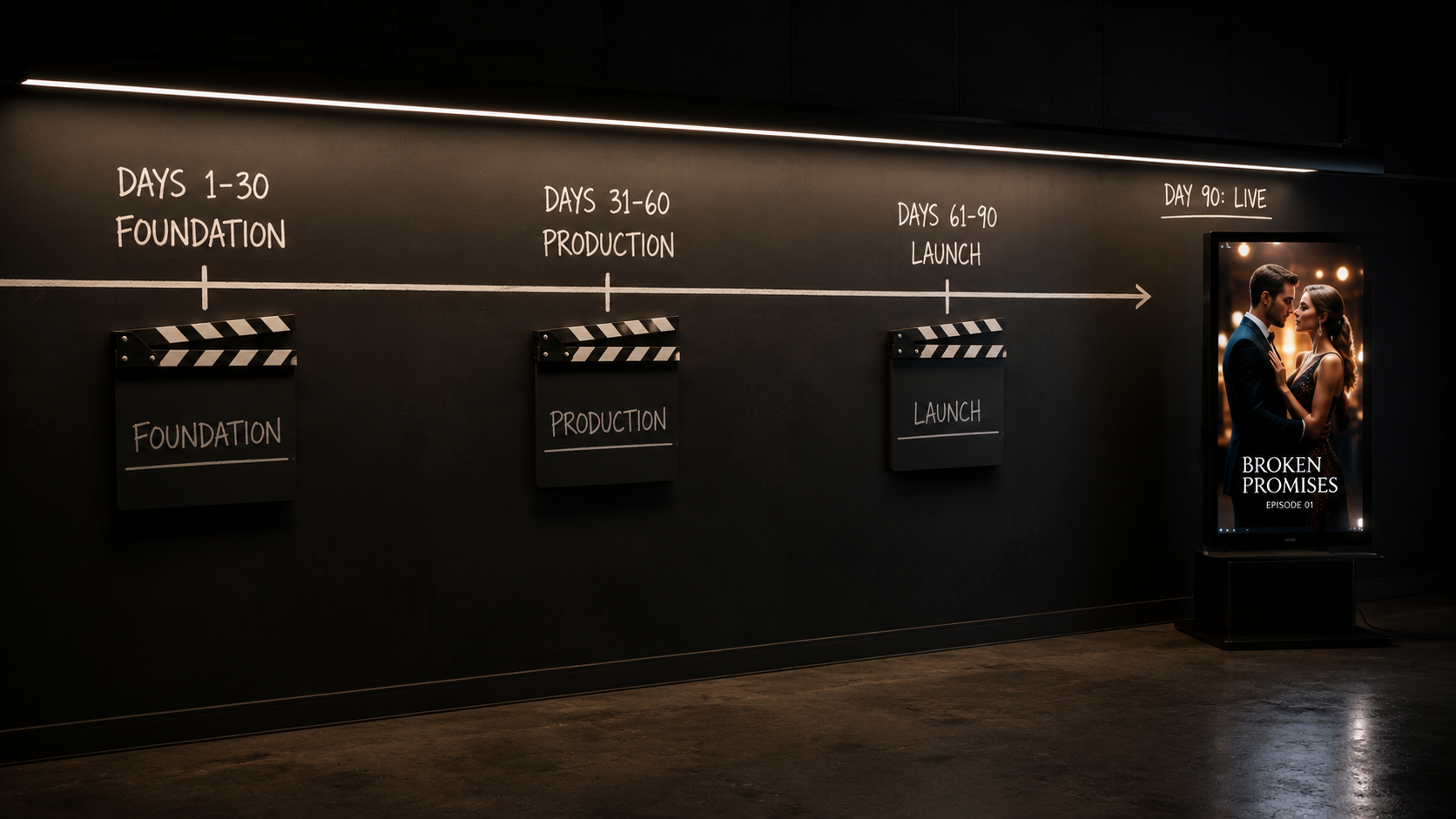
A credible solo schedule for a 60-episode season: one week for the season bible and beat sheets, three to four days for character and location lock, two to three weeks of batched generation running while you review the previous batch, and a final week of assembly and QC. Call it six weeks of focused work. On the revenue side, the format's economics are unusually accessible to small operators: distribution platforms pay for content supply, viewers spend $20 to $40 completing a series they love, and breakout vertical IP gets reverse-adapted into bigger formats. The risks are equally real. Per-title return on ad spend in this market swings between 0.7 and 1.6, most titles are not hits, and the same low barrier that lets you in lets everyone in. The solo strategy that fits this distribution is portfolio logic: ship several seasons a year, read the data, and double down on what converts, something only possible because the pipeline made seasons cheap.
Where solo stops scaling
Honesty requires the ceiling. A solo studio handles one production lane well. The moment you run parallel series, multi-language versions for the localization-driven global market, or platform supply deals with delivery calendars, review becomes the bottleneck and the operation wants a second person, typically a dedicated reviewer or co-writer. The encouraging part is that the pipeline does not change as you grow; on a template-based canvas, scaling from one season to four is more queue, not more infrastructure. Two people running templated workflows can plausibly operate what the industry would have called a boutique studio three years ago.
Should you do it?
If you have story instincts and review discipline, 2026 is the most asymmetric moment this format has offered individuals: a validated $14 billion market, platforms hungry for supply, and a production cost curve that just fell off a cliff. Start by internalizing the format rules and the monetization mechanics from our guides, then build your pipeline before your pilot. The MinionArts Vertex template library exists so that the studio part is already built; what the market is actually short of is people who can run it with judgment.