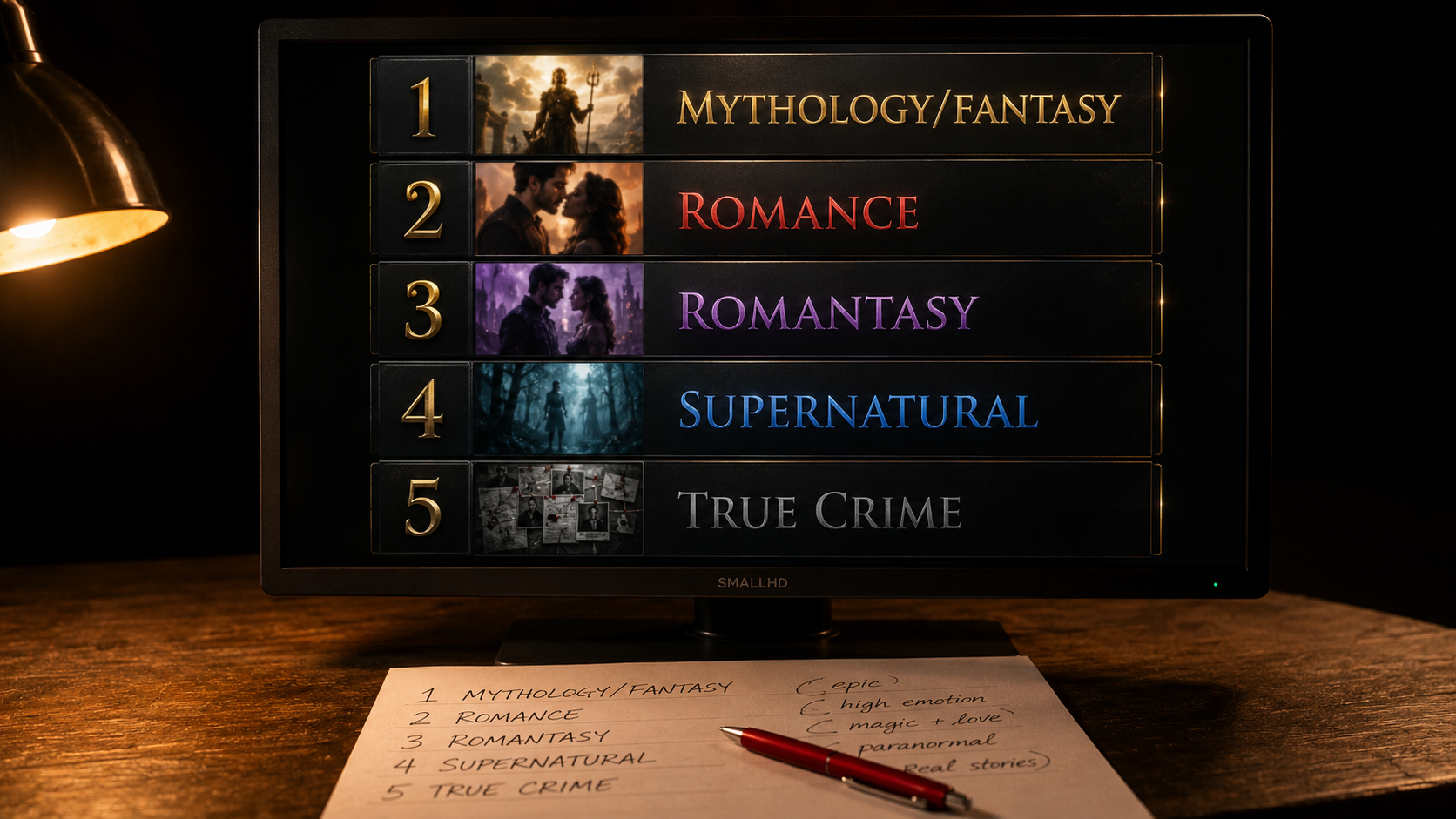
Microdrama genres are not equal terrain for AI production in 2026. Mythology and fantasy give AI the clearest production advantages: visual effects at scales that live action cannot match at vertical budgets. Romance remains the format's highest-revenue engine globally. Romantasy is the fastest-growing hybrid in the US market. True crime and documentary microseries are the underserved frontier. And a small cluster of genres, naturalistic slice-of-life, quiet literary character studies, and comedy requiring precise timing, remain harder for AI to execute reliably at scale. Choosing the right genre for your first AI microdrama season on MinionArts Vertex is the decision that determines your production cost, your platform fit, and your probability of commercial return.
Tier 1 for AI production: mythology, fantasy, supernatural, historical
DataEye's 2026 analysis is explicit: "For genres such as mythological fantasy and historical stories, AI offers clear advantages, enabling visual effects that would otherwise be difficult or costly to achieve." These are the genres where the cost case for AI is strongest, because the alternative is not live-action at $2,000 to $3,000 per finished minute but live-action with VFX at $10,000 to $50,000 per finished minute or more. A supernatural battle scene, a mythological realm, an ancient empire's court, are all production-practical in AI at the $30 to $150 per finished minute range that a Vertex pipeline achieves. They are not production-practical in live-action at any microdrama budget.
Global Times reported in March 2026 that entire mythological worlds from Chinese classical literature, previously deemed too costly for the screen, are now being produced at scale using Seedance 2.0 and similar tools. The AI microdrama sector saw net profit margins above 50 percent in some fantasy formats. VML's analysis noted that AI excels at "spectacle like fantasy worlds, exaggerated plots, surreal humor," confirming that the genre advantage is real and measurable in production economics. On MinionArts Vertex, the workflow for mythological and fantasy production includes environment generation nodes that produce consistent fantasy locations without physical set construction: palace interiors, mystical forests, supernatural realms that appear episode after episode from the same locked environment references.
Tier 1 for revenue: CEO romance, billionaire fantasy, revenge arcs
Romance and its variants remain the format's commercial foundation globally. ReelShort's 500-million-view breakout title The Double Life of My Billionaire Husband and the consistent dominance of CEO, billionaire, and forbidden romance in platform top charts confirm that this genre drives the unlock conversion economics the format runs on. The emotional intensity, power hierarchy dynamics, and cliffhanger-native plot structures of romance are precisely aligned with the Beat Engine and the parasocial bond mechanics that make microdramas commercially viable. Vigloo's analysis of their performance data confirms it plainly: "Romance delivers fast pacing, strong conflict and emotionally charged storytelling most effectively."
For AI production specifically, romance's face-forward 9:16 grammar and its reliance on reaction shots rather than spatial spectacle maps well onto the strengths of current generation models. Seedance 2.0's phoneme-level lipsync is most impactful in dialogue-heavy romantic confrontation scenes. Character lock matters most here because viewers form the strongest parasocial bonds with romance leads, and identity drift is most damaging in the genre where the face is the entire emotional channel. Vertex romance templates default to close-up character generation with expression variants covering romantic tension, betrayal, and distress, the three emotional registers that drive the genre's engagement mechanics.
Tier 2 and rising: romantasy and sci-fi
Vigloo's ContentAsia interview identified romantasy, a blend of romance and fantasy, as a major US trend. Holywater's AI production of a Formula One series confirms that sports and action hybrids are expanding the format's genre range. Dashverse CEO Tanveer Ali noted that AI content has allowed genre expansion into sci-fi and LGBTQ+ shows that were previously too niche to justify live-action production costs. For AI producers, these hybrid genres are compelling because they combine the revenue mechanics of romance with the production advantages of fantasy: the emotional engine drives conversion while the AI-native visual language drives the spectacle that differentiates the series in a crowded market. The Vertex workflow handles these hybrids by combining the character lock approach from romance templates with the environment generation approach from fantasy templates in a single canvas.
The frontier: true crime, documentary, vertical sport
VML's 2026 analysis noted the format is expanding beyond soapy drama into wildlife documentary microseries and other non-fiction adjacent formats. True crime in vertical format has almost no established competition and a proven global audience appetite. Vertical sport, as Holywater's F1 series demonstrated, achieves production at budgets that make live-action sport coverage impossible for small producers. These are pre-competition keyword territories for content and for distribution platform listings. The platform infrastructure to distribute them exists on DramaBox and ShortMax, and the AI production advantages in these genres, generating action sequences and environments that would require expensive location permissions in live production, are if anything larger than in narrative drama.
Genre selection in the Vertex workflow
MinionArts Vertex carries genre-specific production logic in its template library. Fantasy and mythology templates default to wider environment shots, epic lighting setups, and supernatural effect layer nodes. Romance templates default to close-up character generation, intimate lighting setups, and dialogue-heavy beat structures. Hybrid genres load from combined template bases. The genre decision upstream from the pipeline is therefore also a production configuration decision: choosing mythology-fantasy on Vertex means your character lock includes environment lock, your generation nodes route to models strong on spectacle and scale, and your beat sheet structure handles the slower world-reveal pacing that fantasy allows alongside the cliffhanger discipline the format demands. Choose your genre, load the right Vertex template, and the production configuration follows.