Adapting a novel or existing IP into a vertical series is the dominant content strategy for the $11 billion microdrama industry in 2026, and AI production has made it viable at budgets that independent producers can access without studio backing. China's duanju industry runs almost entirely on web novel IP: ByteDance, Tencent, and Kuaishou platforms leverage IP pipelines from COL Group, China Literature, and Tomato Novel to convert proven reader bases into paying vertical drama audiences. Deadline's September 2025 reporting confirmed that nearly 60 percent of China's 830 million microdrama viewers pay or transact, a conversion rate that the industry attributes in large part to the audience pre-qualification that proven IP provides. In the US, Disney selected DramaBox for its 2025 accelerator class and announced in-development projects adapting Disney Publishing YA novels and Disney Music albums. In India, Sameer Sippy Productions executed a cross-border IP licensing deal to adapt 1970s Bollywood films into vertical microdramas for ReelShort, retitling the 1983 film Kissi Se Na Kehna as The Billionaire's Fake Wife. The IP-to-vertical pipeline is not a niche strategy. It is the industry's primary content engine.
Why IP works better than original in vertical drama
Adapted IP enters vertical drama with three structural advantages over original content. First, an existing reader or viewer base that already knows the characters and wants more story, lowering the acquisition cost of the first free episode. Second, a validated emotional structure: a novel that held readers' attention across 300 pages has proven its hook-tension-escalation mechanics work in the target market, which transfers to the vertical format after adaptation. Third, recognizable search terms: a novel title or franchise name generates organic search traffic to the platform listing in a way that original titles do not. Filmustage's 2026 analysis of the ReelShort vs DramaBox competitive landscape noted that local dramas adapting popular online novels achieve higher long-term engagement than translated Chinese content, confirming that the IP advantage is real and market-specific rather than generic.
The creative conversion process
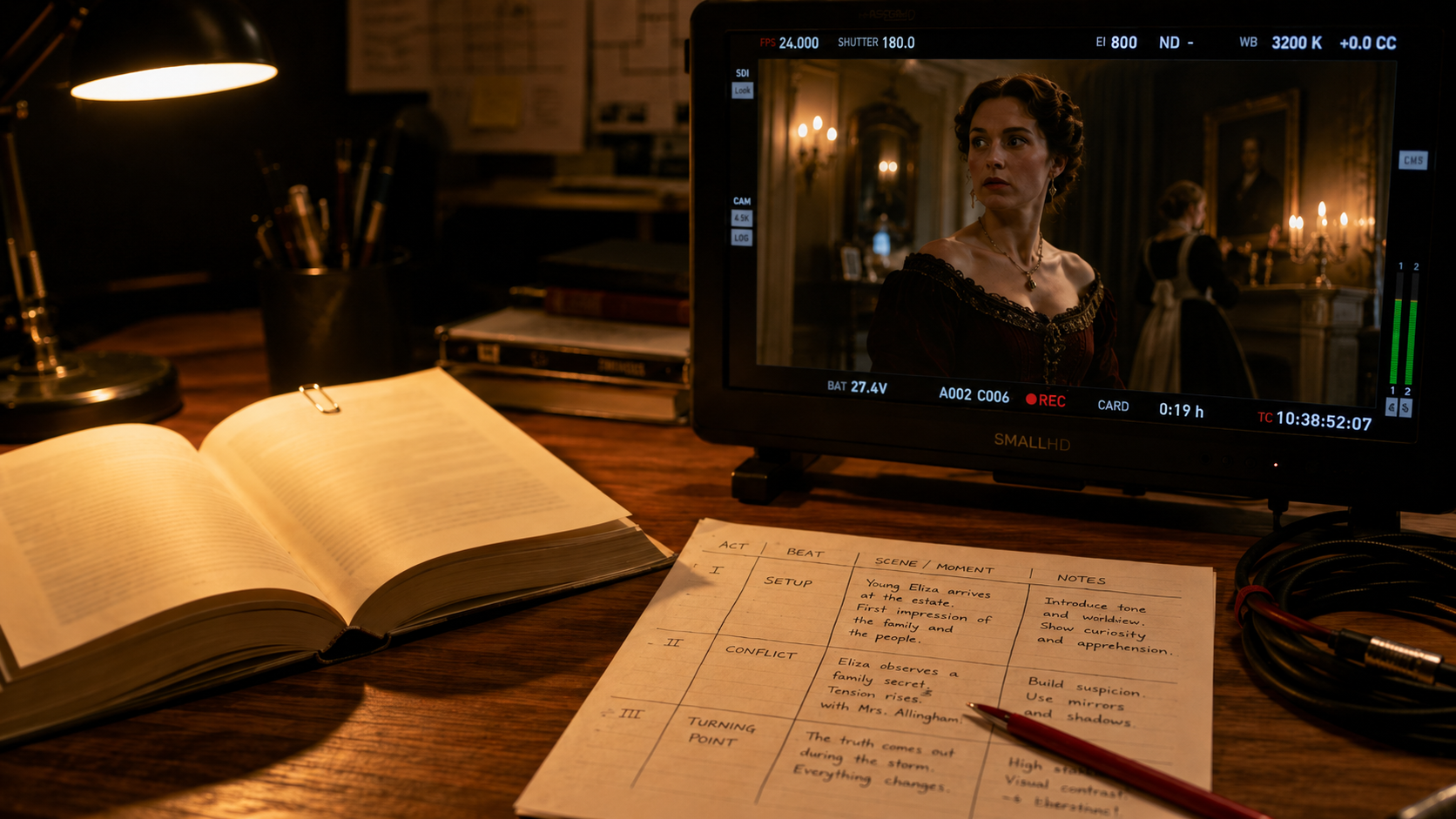
Adapting a novel to vertical drama is not compression. It is decomposition and reconstruction around the format's Beat Engine. A 300-page novel that takes a reader 6 to 8 hours contains roughly the same narrative content as a 90-episode vertical series totaling 135 minutes of viewing, but the distribution of that content is completely different. Novels pace across chapters that can span pages without a tension event. Vertical episodes require a hook, friction beat, spike, and Zeigarnik cut every 90 seconds. The adaptation process extracts the novel's core emotional events, its betrayals, revelations, romantic escalations, and power reversals, identifies the ones with highest tension-to-page-count efficiency, sequences them for maximum cliffhanger density, and reconstructs scene-by-scene around the Beat Engine rather than the novel's chapter structure.
Vitrina's December 2025 analysis of the Sippy-Service Street IP deal described this process as "Narrative Decoupling": extracting the plot structure while stripping away the original language and cultural context, then rebuilding for the target market and format. For AI production specifically, the extraction phase produces a season beat sheet directly usable as pipeline input, which means the adaptation work and the production preparation are the same work rather than sequential steps.
Genre selection for vertical adaptation
Not all IP genres adapt equally well. The format's best-performing genres in 2026 are romance (specifically CEO and billionaire arcs), revenge and betrayal, supernatural and werewolf, and mythology and fantasy. The common thread is emotional extremity and social hierarchy, which map naturally to the close-up face-forward grammar of 9:16 and to the format's dopamine architecture. IP in these genres with proven audiences on novel platforms (Wattpad, Webnovel, Tapas, Royal Road, Pratilipi) is the highest-probability conversion target. IP in genres with less emotional extremity, literary fiction, quiet character studies, procedural mysteries without relationship stakes, requires significant creative transformation to work in vertical and is less efficient than adapting genre-native material.
The Shanghai International Film Festival's 2026 Multiverse Micro-Drama Project announced a global open call for microdrama adaptations of Fanqie Novel IPs, the first major festival-adjacent IP licensing structure for vertical drama, signaling the institutionalization of the IP pipeline at the international level.
Legal structure for IP adaptation
IP adaptation for vertical drama requires explicit rights. The most common structures in 2026 are: direct option agreements for novel IP, typically 12 to 24 month exclusive development windows with renewal options; co-production agreements where the IP holder takes a back-end share in exchange for development rights; and platform commissioning agreements where the distribution platform funds adaptation in exchange for exclusive platform rights for a specified window. The Sippy-Service Street deal structure used a non-exclusive licensing agreement to the adaptation company with ReelShort as the named distribution destination. For AI-produced vertical drama specifically, the agreement should explicitly address synthetic performers, AI-generated character likenesses, and the use of AI tools in the production process, as these are increasingly specified in 2026 contract templates following the SAG-AFTRA 2026 provisions.
Using AI in the adaptation pipeline
AI's role in IP adaptation extends beyond the production pipeline into the creative phase. LLM-assisted beat sheet generation from novel source material significantly compresses the adaptation timeline: a 300-page novel can be processed into a 90-episode beat sheet structure in hours rather than weeks when the extraction and sequencing logic is LLM-assisted and human-reviewed. Character reference generation from novel descriptions produces visual casting that the IP holder can review and approve before production begins. This creates a pre-production approval workflow that did not exist in live-action adaptation, where visual casting requires physical casting and hair and makeup tests before any stakeholder review. On MinionArts Vertex, the approved character references load directly into the character lock nodes and the approved beat sheet loads into the season input, meaning the adaptation approval process and the production start are separated by days rather than months.