Producing a 50-episode AI microdrama on a lean budget is not a theoretical proposition in 2026. C21Media reported in May 2026 that microdrama directors in China are producing completed seasons using AI tools including Seedance 2.0 for as little as $30 per finished minute, with no cameras, crew, or human performers. A 50-episode season at 90 seconds per episode totals 75 minutes of finished content. At that benchmark, the full season generation cost sits at approximately $2,250. The number is real, but it assumes a mature pipeline, structured prompting, and character lock discipline that keeps usable-take rates above 90 percent. Here is the honest cost model for a team building this for the first time on MinionArts Vertex, with the factors that push costs up and the decisions that hold them down.
The cost baseline: what China's $30/min figure actually includes
The $30 per finished minute figure cited in the New York Times and C21Media reporting covers AI video generation and basic audio, running on optimized pipelines with pre-built templates, high usable-take rates, and no iteration overhead. It does not include script development, character design and lock, music licensing or generation, subtitle production, or platform delivery preparation. For a first production on a new pipeline, the more honest total cost model adds these layers back in.
For context, traditional live-action microdrama seasons in China run 7 to 12 days on set at budgets under $300,000 for 60 to 80 episodes, which works out to roughly $2,000 to $3,000 per finished minute. AI production targeting the same output cuts that to one-fifth to one-tenth by eliminating cast fees, location costs, crew, and equipment rental. The cost that remains is creative labor (writing and review) and generation credits.
Model-by-model cost estimate for 50 episodes
A 50-episode season at 90 seconds per episode requires approximately 300 to 500 individual generated clips averaging 3 to 5 seconds each. As of mid 2026, per-clip generation cost across the primary models is: Veo 3.1 Standard at approximately $0.40 per second, making a 5-second clip $2.00; Kling 3.0 at approximately $0.50 to $2.50 per 10-second clip at 1080p, with the Omni variant higher; Seedance 2.0 at a similar per-clip range depending on resolution and length; value-tier models such as Wan 2.6 at significantly lower cost per clip for B-roll and non-critical shots.
Using a production routing that reserves Veo 3.1 for approximately 10 percent of shots (hero moments and paid social hooks), Kling 3.0 or Seedance 2.0 for 60 percent (dialogue and action scenes), and value-tier models for the remaining 30 percent (B-roll and context shots), a 400-clip season runs to approximately $600 to $900 in raw generation cost at a 90 percent usable-take rate. Budget an additional 15 to 20 percent for failed takes requiring regeneration, bringing the generation total to $700 to $1,100 for the 50-episode run.
Voice and lipsync adds approximately $100 to $200 for ElevenLabs at the Creator plan ($22/month) across the production period, with additional per-character voice generation costs. Music generation through AI tools adds $50 to $100 for a recurring cue library. Total generation and tool budget for a 50-episode season: $850 to $1,400.
Labor: what AI eliminates and what remains
AI eliminates cast fees, location costs, crew day rates, camera and lighting equipment, and post-production color grading in the traditional sense. What remains is creative labor that compounds in value rather than scales with episode count. Script writing for a 50-episode season with a solid formula takes roughly 40 to 60 hours for an experienced vertical drama writer. Character design and lock, generating reference libraries and iterating until identity is stable, takes 8 to 12 hours. Review of generated output across the season, the QC pass per episode, takes approximately 2 to 3 hours of human time per episode, or 100 to 150 hours total for 50 episodes. At a creator's own labor rate, this is the primary cost variable in the model.
The Vertex template approach on MinionArts reduces the review burden because structured generation produces more consistent output than open-ended prompting, and the batch processing capability means the producer is reviewing finished episode segments rather than operating tools per clip. Teams that have built and tested their pipeline report that episode 2 through 50 production time falls to 1 to 2 hours of active human time per episode after the template is established.
Total cost model for a first 50-episode season
| Cost element | Estimate range |
|---|---|
| Video generation (300-500 clips, routed) | $700 to $1,100 |
| Voice and lipsync (ElevenLabs + lipsync pass) | $100 to $200 |
| Music and SFX generation | $50 to $100 |
| Tool subscriptions (1 month active production) | $100 to $300 |
| Script development (external writer, optional) | $500 to $2,000 |
| Review and QC labor (at creator's rate) | Variable |
| Total generation and tools | $950 to $1,700 |
How Vertex changes the cost trajectory
The MinionArts Vertex platform changes the economics not at the per-clip level but at the pipeline level. A 50-episode season on disconnected tools requires reconstructing the generation context, model settings, and character references for each episode. A 50-episode season on Vertex runs from a single template that maintains character references, model routing, and beat structure parameters across the whole run. The usable-take rate improvement from structured, reference-anchored generation versus open-ended prompting is the primary cost lever. Every percentage point improvement in usable-take rate reduces the generation budget proportionally. Teams reporting 90-plus percent usable-take rates are running structured pipelines, not free prompting.
The second Vertex cost advantage is localization. A single season produced in English on Vertex can produce Hindi, Spanish, Bahasa, and French versions by running the voice and lipsync nodes with language-specific voice IDs against the same video output. Incremental cost per additional language is approximately $50 to $150 in voice generation and lipsync processing, with no additional video generation required. The global distribution economics of microdrama, where localization is increasingly a primary revenue multiplier, make this architecture compounding in value.
The realistic timeline for 50 episodes
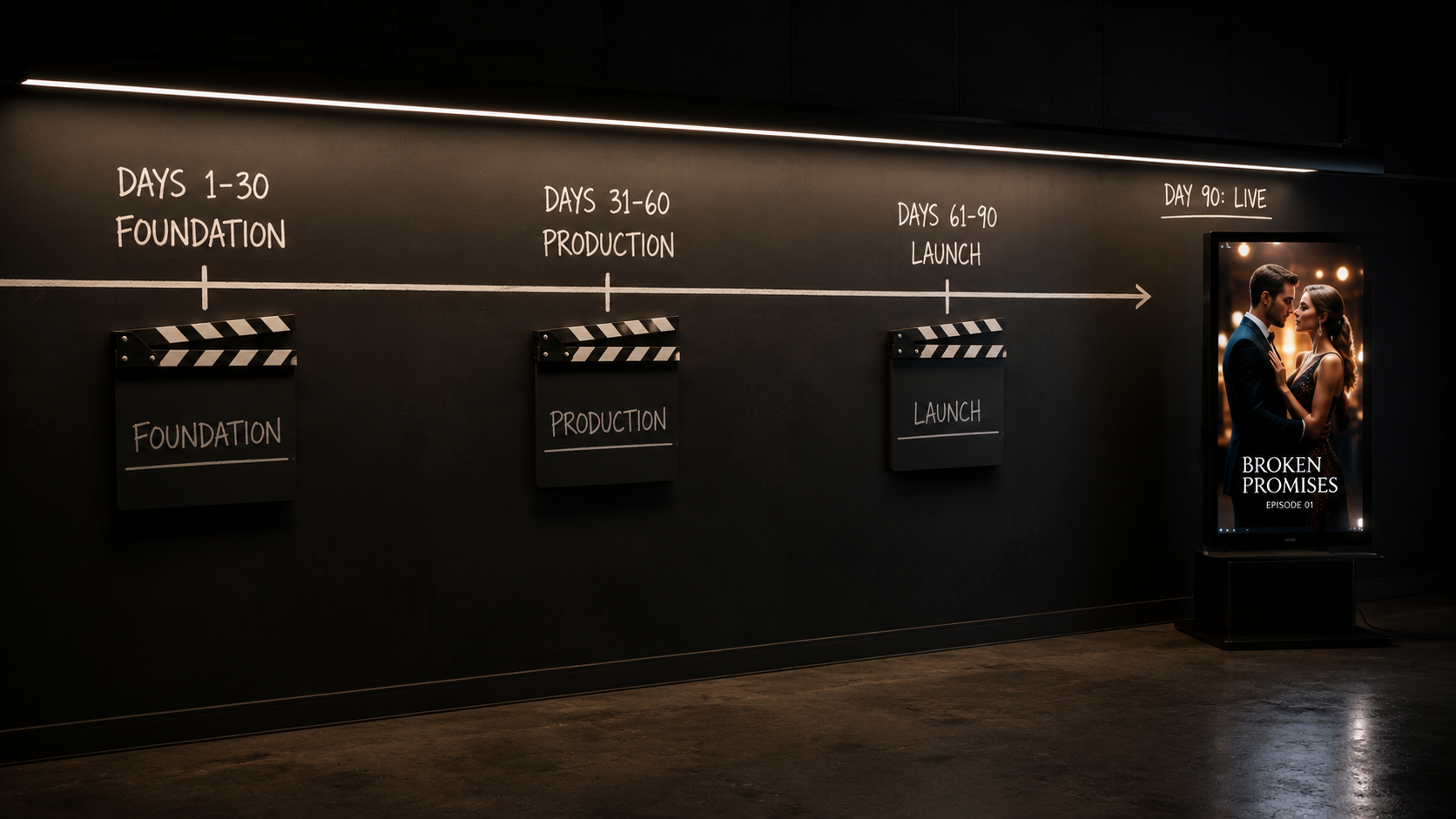
With an established Vertex pipeline: season bible and beat sheets in 5 to 7 days; character and location lock in 3 to 4 days; generation running in batches across 10 to 14 days; lipsync, music, and assembly in 5 to 7 days; QC and delivery preparation in 3 to 5 days. Total: 4 to 6 weeks. This aligns with the benchmarks set by the early AI-native microdrama productions including Vigloo's six-week AI-generated season. The first production takes the full timeline. Subsequent seasons on the same template, with existing character locks, run in 3 to 4 weeks.