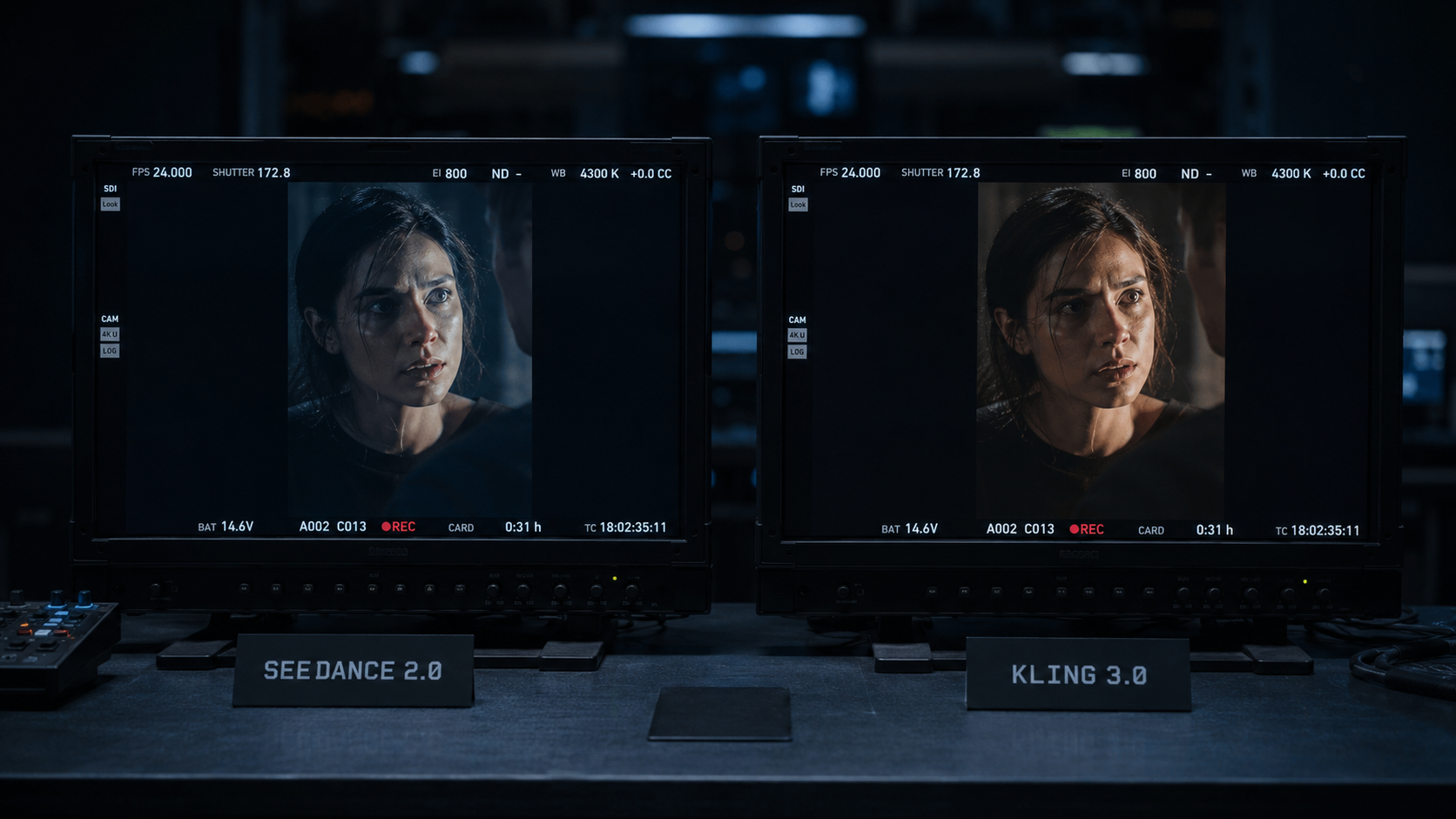
The Seedance 2.0 vs Kling 3.0 comparison is the most consequential model decision for AI microdrama producers in 2026. Both models launched within days of each other in early 2026, both immediately drew strong reactions across the production community, and both are now in active use across serious AI film pipelines. The comparison that matters for microdrama specifically is not which model is "better overall" but which handles each scene type in a 90-second vertical episode most cost-effectively. The answer is that they are different production tools with overlapping capability and specific domains where each clearly leads.
What each model is actually built for
Seedance 2.0, developed by ByteDance, is built around director-level control through multimodal reference input. It accepts up to 9 reference images, 3 video clips, and 3 audio clips alongside the text prompt, operates a unified audio-video architecture that generates dialogue, ambient sound, and background music simultaneously with the visual output, and preserves character identity across multi-shot sequences via the @Character tag system at a reported 95 percent success rate. One detailed analysis described Seedance's approach as treating the character reference like a director briefing an actor, carrying visual identity, movement style, and voice characteristics into new scenes coherently. Seedance 2.0 sits at or near the top of public model evaluations including VideoGen-Eval on composite quality scores, beating competing models across multiple metrics in independent testing.
Kling 3.0, developed by Kuaishou, is built around cinematic motion quality and raw visual fidelity. It produces native 4K at 60fps, the highest resolution output available in the mid-tier commercial market as of mid 2026. Its Visual Chain-of-Thought (vCoT) architecture produces physically grounded scenes with natural human movement and strong physics simulation. Curious Refuge's independent review gave Kling 3.0 an overall score of approximately 8.26 out of 10 with especially strong marks in visual fidelity and consistency. Chase Jarvis, reviewing extensively after 150-plus generations including comparative testing, described it as likely the best general-purpose video model on the market for realistic footage, noting cost and render speed as the primary tradeoffs.
Head-to-head on microdrama scene types
Dialogue and lipsync scenes. Seedance 2.0 leads clearly. Its native audio-video joint generation produces synchronized dialogue with natural reverb and ambient sound without post-processing. The phoneme-level approach means mouth movement matches audio at a precision that post-hoc lipsync cannot fully replicate. For the dialogue-heavy confrontation and revelation scenes that constitute the bulk of microdrama runtime, Seedance's integrated approach is the production-rational choice.
Action sequences and motion direction. Kling 3.0 leads. Its multi-shot capability, natural human movement physics, and strong action scene handling produce the most grounded results for confrontations, physical altercations, and movement-directed scenes. After the initial Kling 2.6 generation era, version 3.0's multi-shot workflow, operating through a tab-based system per shot, meaningfully improved narrative coherence across connected action beats. Independent producers who tested both models extensively reported that Kling 3.0's action output felt "grounded" where earlier models and some competing outputs felt artificial.
Character consistency across shots. Seedance 2.0 leads for complex multi-shot sequences. The @Character tag system with its 95 percent reported identity preservation rate outperforms Kling 3.0's Subject Consistency 3.0 for sequences requiring the same character to appear consistently across 8 to 12 shots. Kling 3.0's system, which uses a 3 to 8 second reference video to lock a subject, performs well on single-shot hero scenes and is described as improving but currently better suited to those than to complex multi-shot narrative sequences.
Resolution and output quality. Kling 3.0 leads on raw resolution: native 4K at 60fps is unmatched in this tier. Seedance 2.0 maxes at 2K but scores higher on composite quality benchmarks and the Video Arena leaderboard, suggesting that its visual coherence and overall production value exceed what raw resolution numbers capture. For mobile vertical drama viewed on phone screens, 4K vs 2K is largely imperceptible, which means Seedance's overall quality advantage matters more for microdrama use cases than Kling's resolution advantage.
Native audio. Seedance 2.0 wins decisively. Its native audio-video joint generation produces synchronized dialogue, environmental sound, and music. Kling 3.0 has limited native audio capabilities and most production workflows add audio separately. In a format where ambient sound and synchronized dialogue are the primary emotional signal when screen sound is on, this is a material production difference.
API availability and pricing. Kling 3.0's API is live and available on aggregator platforms. Seedance 2.0's broader API is pending, which creates a pipeline integration limitation for teams wanting to automate generation at scale. Cost per clip at mid-tier is broadly comparable: $0.50 to $2.50 per 10-second clip at 1080p for both models depending on variant and platform.
The production routing recommendation
For AI microdrama production in 2026, route by scene type rather than committing to one model. Seedance 2.0 handles dialogue, lipsync-critical shots, and multi-shot character-consistency sequences. Kling 3.0 handles action, physically grounded motion sequences, and shots where 4K resolution is specifically needed for the delivery context. Veo 3.1 handles hero shots and episode-one hooks where premium output quality justifies the higher per-second cost. Value-tier models handle B-roll and context shots where character face is not central.
On MinionArts Vertex, this routing is a configuration decision per node rather than a per-generation manual choice. The scene type field in the episode JSON drives the model selection at the generation node, and the routing logic persists across all 50 episodes without the producer manually selecting a model for each clip. The result is that the production automatically allocates each scene to the model that handles it best, producing the highest overall quality output at the lowest generation cost for the season.